How prebiotic fiber feeds the brain: the Brainlive science

Updated September 2026 · reviewed by the Brainlive Research Team. We are an independent information resource, not a medical provider, and this article is educational rather than medical advice.
Prebiotic fiber feeds the brain indirectly: because it is not digested in the small intestine, it reaches the colon where gut bacteria ferment it into short-chain fatty acids, and those molecules become one of the chemical signals that travel along the gut-brain axis. In other words, you do not feed the brain directly — you feed the microbiome that talks to it. This is a wellness-support pathway, not a treatment for any disease.
Prebiotic fiber for the brain, explained in one place.
- The short version
- Prebiotic fiber survives digestion, feeds beneficial gut bacteria, and is fermented into short-chain fatty acids that support the gut lining and the gut-brain conversation.
- The key molecules
- Butyrate, propionate and acetate — the short-chain fatty acids your microbes make when they eat fermentable fiber.
- Brainlive's example
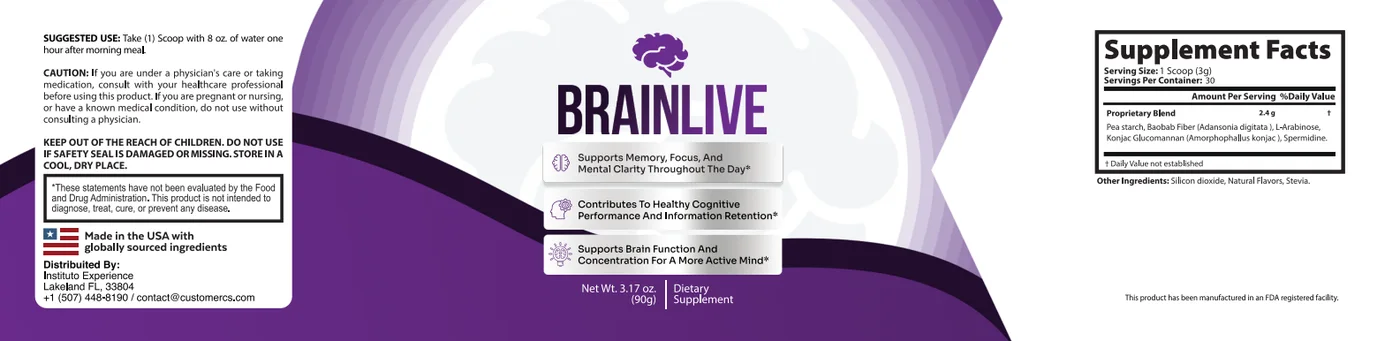
- Three complementary fibers — pea resistant starch, baobab fiber and konjac glucomannan — feed a broader mix of bacteria than any single fiber alone.
- Honest caveat
- The fiber-to-cognition link is a real and active field, but human evidence is early and mixed; treat fiber as general support, not a memory cure.

Most brain-support advice points at the head. This one starts lower down — in the colon, where trillions of bacteria turn the fiber you cannot digest into molecules your body can use. That fermentation is the quiet engine behind the phrase “gut-brain axis,” and it is the mechanism that a formula like Brainlive is built around. Below, we walk the whole pathway in plain language, name the science where it is solid, and flag it where it is still early.
What is prebiotic fiber, and why can't the body digest it?
Prebiotic fiber is a type of dietary fiber that human enzymes cannot break down, so it passes through the stomach and small intestine intact and becomes food for beneficial bacteria in the large intestine. The word “prebiotic” is the giveaway: a prebiotic feeds the microbes, while a probiotic is the microbes. Not all fiber is prebiotic — the defining feature is that it is fermentable, meaning gut bacteria can selectively use it as fuel. That single property, indigestible to you but nourishing to your microbes, is what makes prebiotic fiber the starting point of the whole gut-brain story.
This is also why fiber behaves so differently from a vitamin or a stimulant. A caffeine molecule acts on your brain in minutes; a prebiotic fiber acts on your bacteria over hours and days, and the brain feels the effect only second-hand. It is a slower, more foundational kind of support — less like flipping a switch, more like tending a garden.
How do prebiotic fibers turn into short-chain fatty acids?
Prebiotic fibers become short-chain fatty acids through fermentation: when fiber reaches the colon, resident bacteria break it apart for energy and release short-chain fatty acids as the by-product. This is the same chemistry that turns grape sugar into other compounds when yeast ferments wine — a controlled breakdown that yields something new and useful. In the gut, the useful output is a trio of small molecules that the body then puts to work. How those short-chain fatty acids signal beyond the gut itself is reviewed by Dalile et al., Nature Reviews Gastroenterology & Hepatology, 2019.
What exactly are short-chain fatty acids?
Short-chain fatty acids (SCFAs) are the main products of fiber fermentation, dominated by three: butyrate, propionate and acetate. Butyrate is the standout — it is the preferred fuel source for the cells that line the colon, which means the fiber you eat quite literally helps feed the wall of your own gut. Propionate travels to the liver and is studied in energy metabolism, while acetate is the most abundant and circulates most widely in the bloodstream.
Why does the mix of fibers matter?
Different bacteria prefer different fibers, so the variety of prebiotic fiber you eat shapes the variety of microbes you feed — and a more diverse microbiome is generally considered a healthier one. A single fiber tends to favor a narrow set of bacteria; a blend of fibers with different structures and fermentation speeds supports a broader community. That principle is exactly why Brainlive pairs three fibers rather than relying on one, a point we return to below.
What is the fiber gut-brain axis, and how does the signal travel?
The gut-brain axis is the two-way communication network linking the gut, its microbes, and the brain, and prebiotic fiber influences it by changing what the microbes produce. The signal does not travel one way only. There are at least three routes worth knowing. First, the vagus nerve is a direct physical wire between gut and brainstem, and gut chemistry can influence the messages it carries. Second, the gut is where a large share of the body's serotonin-related activity and other signaling molecules originate, many of them shaped by microbial activity. Third, short-chain fatty acids and related compounds enter the bloodstream and act as circulating messengers.
Butyrate is central to the first step of that chain because it helps maintain the integrity of the gut barrier — the single-cell lining that decides what stays in the gut and what passes into the body. A well-fed, well-sealed barrier is thought to keep the whole conversation calmer and more orderly, which is one reason researchers keep circling back to prebiotic fiber. For a deeper walk-through of this network, our companion piece on the gut-brain axis explained covers it in full.
Which three fibers does Brainlive use as a worked example?
Brainlive is built on three complementary prebiotic fibers, each chosen for a different fermentation profile so they feed a wider range of gut bacteria than any one fiber could. Rather than a generic “fiber” label, the formula names each source, and each has its own long history as a food. Here is how the three compare.
| Fiber | Type | How it behaves in the gut |
|---|---|---|
| Pea resistant starch | Resistant starch | “Resists” digestion and reaches the lower colon largely intact, where it is a well-studied producer of butyrate. |
| Baobab fiber | Soluble fruit fiber | A traditional African superfruit fiber, roughly half fiber by weight and naturally rich in soluble, fermentable material. |
| Konjac glucomannan | Soluble viscous fiber | Forms a thick gel that slows digestion and ferments in the colon; one of the most studied satiety fibers. |
Read individually, each fiber has its own guide on this site — from resistant starch to konjac glucomannan. Taken together, the three deliver a broader fermentation profile in a single once-daily scoop rather than a stack of separate powders.

See what is in every Brainlive scoop
Brainlive combines pea resistant starch, baobab fiber and konjac glucomannan with L-arabinose and spermidine in one naturally flavored daily scoop. The six-tub bundle is the best value at $49 per tub, with free U.S. shipping and a 60-day guarantee.
Order Brainlive — from $49/tubHow do short-chain fatty acids reach and affect the brain?
Short-chain fatty acids influence the brain mainly through indirect routes rather than by acting on neurons like a drug. Because acetate and, to a lesser degree, the others circulate in the blood, they can reach tissues far from the gut and act as signals in energy and appetite regulation. Butyrate's more important job is local: by fueling the gut lining and supporting its barrier, it shapes the overall tone of the gut environment that the vagus nerve and immune system report back to the brain. So the honest framing is that SCFAs set the conditions for good gut-brain signaling far more than they act as a direct brain nutrient. The routes by which microbial short-chain fatty acids reach and influence the brain are set out by Silva et al., Frontiers in Endocrinology, 2020.

Does the fiber and memory evidence actually hold up?
The link between prebiotic fiber, the microbiome and cognition is a real and fast-moving field, but the strongest human evidence is still early and mixed. Much of the most striking work comes from animal studies, where the microbiome can be manipulated in ways that are impossible in people, and animal findings do not automatically transfer to humans. Human trials on prebiotics and mood or thinking exist, but they are often small, short, and inconsistent. What is well established is narrower and more mechanical: fiber feeds beneficial bacteria, fermentation produces SCFAs, and SCFAs support the gut lining. The leap from those facts to “fiber improves memory” is where the science becomes suggestive rather than settled. In a randomised, placebo-controlled trial by Dalile et al., Neuropsychopharmacology, 2020, short-chain fatty acids delivered directly to the colon blunted the cortisol response to a psychosocial stressor in healthy men.
That is why every honest description of prebiotic fiber — including this one — frames it as general wellness support for an already-healthy person, not as a treatment. Brainlive is a food-based supplement that supplies well-studied fibers; it is not a drug and makes no claim to diagnose, treat, cure or prevent any condition. Enthusiasm for the microbiome is warranted, but so is humility about how much is still unknown.
| Claim | How solid is the evidence? |
|---|---|
| Prebiotic fiber feeds beneficial gut bacteria | Well established |
| Fermentation produces short-chain fatty acids | Well established |
| Butyrate helps fuel and support the gut lining | Well supported |
| The gut and brain communicate two-way | Well established in principle |
| Prebiotic fiber measurably improves human memory | Early and mixed — not proven |
How can you get more prebiotic fiber day to day?
The best source of prebiotic fiber is a varied, plant-forward diet, with a supplement used to top up the specific fermentable fibers that are easy to miss. Most adults eat far less fiber than the general 25-to-38-gram daily range dietary guidelines suggest, so there is room for nearly everyone to do more. A few simple moves cover most of the gap:
- Eat the rainbow of plants — onions, garlic, leeks, oats, beans, green bananas and cooled cooked potatoes are classic prebiotic sources.
- Vary your fibers, since different structures feed different microbes; diversity on the plate builds diversity in the gut.
- Increase gradually and hydrate, because fermentation makes gas and a sudden jump can cause bloating.
- Use a targeted blend to fill gaps — a formula like Brainlive supplies three specific fermentable fibers in a consistent daily dose.
For a broader look at fiber-rich eating, see our guide to the best foods for brain health and memory, then compare the packages and pricing if you want a shortcut for the harder-to-hit fibers.

Check today's Brainlive pricing →
When should you talk to a doctor?
Prebiotic fiber is a food, not a medicine, but it still deserves a sensible conversation in some cases. Speak with your doctor before adding a fiber supplement if you are pregnant or nursing, under 18, take any medication, or have a diagnosed digestive condition such as IBS, IBD or a history of bowel obstruction, since viscous fibers can affect how some of these behave. Introduce any new fiber gradually, drink plenty of water, and stop and seek advice if you notice persistent discomfort. Prebiotic fiber supports an already-healthy gut and mind; it is not a substitute for medical care.
Frequently asked questions
How does prebiotic fiber feed the brain?
Prebiotic fiber is not absorbed in the small intestine, so it travels to the colon where gut bacteria ferment it into short-chain fatty acids such as butyrate. Those molecules nourish the gut lining and are one of the signals that travel along the gut-brain axis. It is a supportive process, not a treatment for any condition.
What are short-chain fatty acids and why do they matter for the brain?
Short-chain fatty acids — mainly butyrate, propionate and acetate — are the by-products your gut bacteria make when they ferment prebiotic fiber. They are the main fuel for the cells lining the colon and are studied for their role in gut-barrier integrity and gut-brain signaling. Research is still developing and results vary.
Which three fibers does Brainlive use?
Brainlive combines pea resistant starch, baobab fruit fiber and konjac glucomannan. Each is a different kind of prebiotic fiber, so they feed a broader range of beneficial bacteria than a single fiber would, in one naturally flavored daily scoop.
Is there strong proof that fiber improves memory?
No. The link between fiber, the microbiome and cognition is a genuine and active field of research, but most evidence in people is early and mixed. Prebiotic fiber is best seen as general wellness support for an already-healthy mind, not as a proven memory treatment.
How much prebiotic fiber do most people need?
Most adults fall short of the general 25 to 38 grams of total daily fiber that dietary guidelines suggest. Whole plants should come first; a prebiotic supplement like Brainlive can help top up the specific fermentable fibers that feed the microbiome. Increase fiber gradually and drink plenty of water.
Can prebiotic fiber cause bloating or gas?
It can, especially at first, because fermentation naturally produces gas. Starting with a smaller amount, staying hydrated and building up over one to two weeks usually helps the gut adjust. If discomfort persists, lower the dose and speak with your doctor.
Try Brainlive risk-free for 60 days →
Brainlive is a dietary supplement, not a treatment for any medical condition. These statements have not been evaluated by the Food and Drug Administration. This product is not intended to diagnose, treat, cure or prevent any disease. Always consult a qualified healthcare professional about your individual needs.
References & further reading
- National Center for Complementary and Integrative Health (NCCIH). Probiotics: What You Need To Know. nccih.nih.gov/health/probiotics-what-you-need-to-know
- Dalile B, Van Oudenhove L, Vervliet B, Verbeke K. The role of short-chain fatty acids in microbiota-gut-brain communication. Nature Reviews Gastroenterology & Hepatology, 2019. pubmed.ncbi.nlm.nih.gov/31123355
- Harvard T.H. Chan School of Public Health, The Nutrition Source. Fiber. nutritionsource.hsph.harvard.edu/carbohydrates/fiber
- Examine.com. Glucomannan (konjac fiber) — evidence-based summary. examine.com/supplements/glucomannan
- Mayo Clinic. Dietary fiber: Essential for a healthy diet. mayoclinic.org/.../fiber/art-20043983
- Silva YP, Bernardi A, Frozza RL. The Role of Short-Chain Fatty Acids From Gut Microbiota in Gut-Brain Communication. Frontiers in Endocrinology, 2020. pubmed.ncbi.nlm.nih.gov/32082260
- Dalile B, Vervliet B, Bergonzelli G, Verbeke K, Van Oudenhove L. Colon-delivered short-chain fatty acids attenuate the cortisol response to psychosocial stress in healthy men: a randomized, placebo-controlled trial. Neuropsychopharmacology, 2020. pubmed.ncbi.nlm.nih.gov/32521538
These references describe the ingredients and mechanisms in general terms and do not constitute evidence that any product treats, cures or prevents any condition.
Keep reading: the gut-brain axis explained · best foods for brain health and memory · back to the Brainlive blog · homepage.